
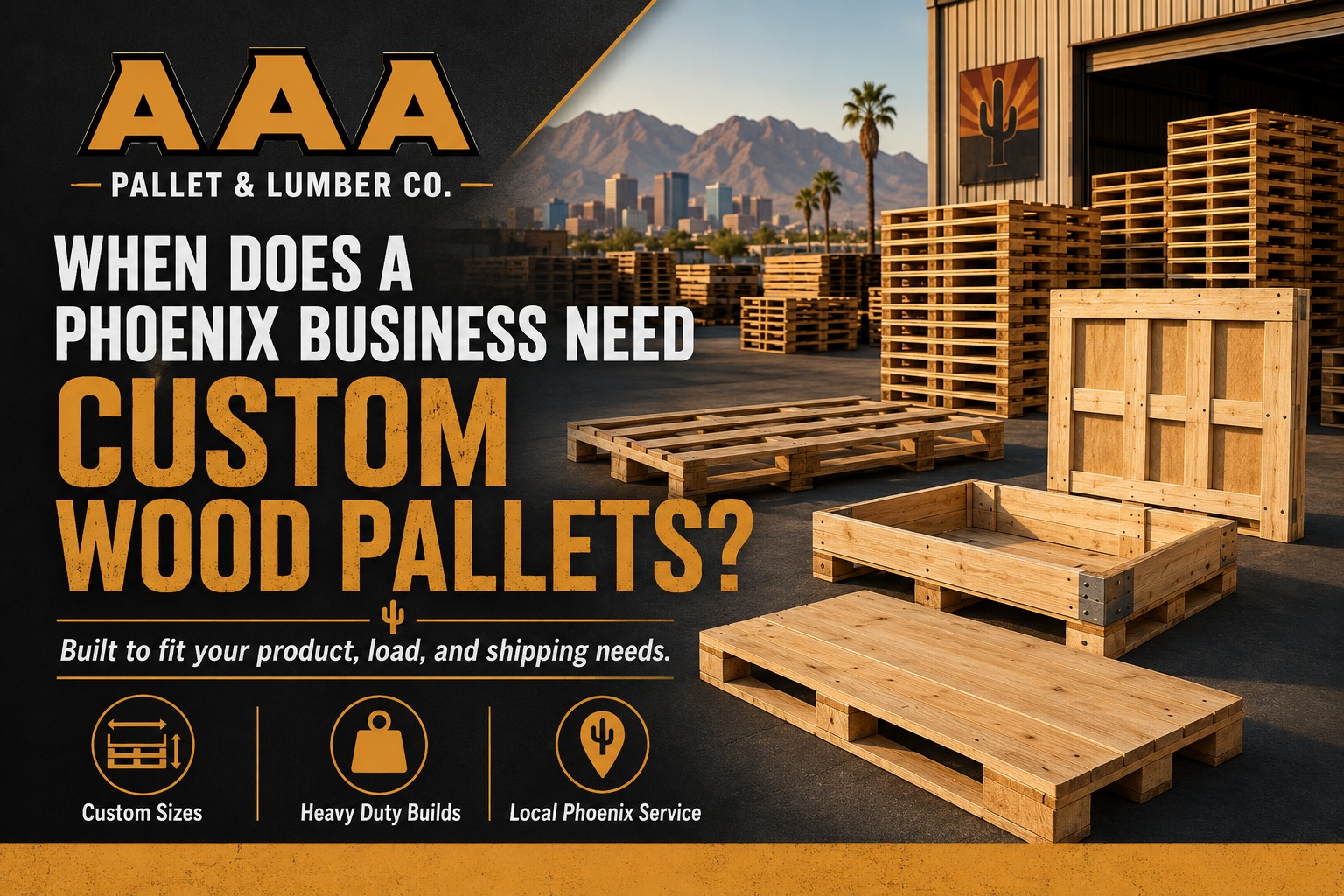
The 48 by 40 inch pallet is familiar in warehouses across the country. It works well for many products, moves easily through common distribution systems, and is widely available in both new and used grades.
It is not a universal answer. A pallet should support the product and fit the way the load moves through the warehouse. When the load hangs over the edges, places weight in unusual locations, or cannot be approached properly by a forklift, a custom pallet may be the more practical choice.
Product Overhang Is an Early Warning
Boxes that extend beyond the pallet deck are more likely to be crushed, punctured, or shifted during handling. Stretch wrap cannot correct a poor fit beneath the load.
A custom footprint can keep the product inside the pallet perimeter. This is particularly useful for long equipment, cabinets, fabricated components, building materials, and products that do not pack neatly into standard cartons.
The opposite problem also occurs. A pallet that is much larger than the product wastes trailer and warehouse space while making the load harder to secure.
Total Weight Does Not Tell the Whole Story
Two loads can weigh the same while placing very different demands on a pallet. A group of evenly distributed cartons is not comparable to a machine that concentrates most of its weight on four narrow feet.
Tell the pallet supplier where the weight rests and whether the load has an unusual center of gravity. Drums, coils, machinery, stone products, and metal components may need deck boards or stringers arranged around specific pressure points.
How the pallet will be supported also matters. A pallet sitting flat on a floor behaves differently from one spanning warehouse rack beams.
Consider Every Handling Point
The design should account for forklifts, pallet jacks, conveyors, racks, trailers, and storage systems. Fork entry direction can determine the stringer layout and whether a two way or four way design is appropriate.
Measure any conveyor openings, rack spacing, and trailer restrictions before ordering. A pallet that supports the product but cannot move through the customer’s equipment has not solved the complete problem.
International shipments may add another requirement. If solid wood packaging is traveling to a country that follows ISPM 15, the custom pallet may need approved treatment and marking.
Give the Supplier Useful Information
Begin with the product length, width, height, and loaded weight. Explain how the weight is distributed and how the product will be attached or wrapped.
The supplier should also know whether the pallet is intended for one trip or repeated use, whether it will be stored indoors or outside, and how many units are needed. Photographs, drawings, or a sample product can clear up details that measurements alone may miss.
Request Custom Pallets From AAA Pallet
AAA Pallet & Lumber Company builds new wood pallets and skids to customer specifications for size, shape, strength, and quality. We also supply new, used, recycled, heat treated, and export pallets throughout the Phoenix metropolitan area.
Call 602 278 1450 to discuss your load and receive a free pallet quote.
Get a hold of AAA Pallet & Lumber Co., for all of your pallet needs, we sell new and new pallets, export pallets, and can even recycle your used pallets. Call us at 602-278-1450 for more information.