
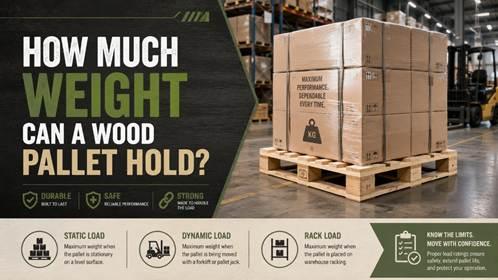
A shipment may weigh 1,800 pounds and appear well within the capacity of a standard wood pallet. That does not automatically make the pallet suitable. The answer depends on where the weight sits, how the pallet will be supported and whether it will remain on the floor, travel on forklift tines or span warehouse rack beams.
This is why pallet capacity cannot be chosen from one general number. The complete handling route matters as much as the total weight.
Static, Dynamic and Racking Capacity Are Different
Static capacity describes a pallet supporting a load while resting on a flat surface. Dynamic capacity applies when the loaded pallet is being lifted or moved by a forklift or pallet jack. Racking capacity concerns a pallet supported across rack beams rather than across its full underside.
The same pallet can perform differently in those three situations. Floor support spreads forces across more of the structure. Fork tines and rack beams leave sections unsupported, allowing deck boards or stringers to bend. A capacity figure for floor storage should never be assumed to apply in an open rack.
The lowest relevant capacity should guide the shipment.
Load Distribution Can Change the Answer
Two products with the same total weight may place different demands on a pallet. Cases covering most of the deck create a broad load. Machinery standing on four small feet concentrates the weight into a few pressure points.
Drums, coils, stone, metal parts and fabricated equipment can also create unusual loads. A heavy section placed at one end may affect balance during forklift travel. A narrow item resting between deck boards may require additional boards or a different stringer arrangement.
Before ordering pallets, identify the product’s center of gravity and show where it contacts the deck. Photographs or a simple drawing can be more useful than the weight alone.
Pallet Design and Lumber Condition Matter
Pallet size does not reveal its strength. Deck board thickness, board spacing, stringer or block design, fasteners, lumber species and moisture condition all influence performance.
A new pallet built for a known load can be designed around the intended handling system. A used pallet may still offer excellent service, but its condition should be checked. Split stringers, missing boards, loose fasteners, heavy wear or previous repairs can reduce confidence in the original specification.
Used pallets should be matched to the job rather than selected only by footprint. A sound 48 by 40 inch pallet may suit many routine loads, while heavy or unusually shaped products may need a new custom pallet or skid.
Warehouse Equipment Must Be Included
A pallet does not work alone. Forklift tine length and spacing, pallet jack clearance, conveyor gaps and rack beam spacing affect the support it receives.
A design that performs well on one conveyor may catch or deflect on another. A pallet intended for repeated rack storage may need more stiffness than one used for a single local trip. Repeated handling also adds wear.
Tell the pallet supplier whether the unit will be stacked, racked, placed on a floor or transferred through automated equipment. Also explain whether it is intended for one shipment or many cycles.
Avoid Guessing From an Average Capacity
Online capacity estimates can be useful for general comparison, but they do not certify an individual pallet for a particular load. Laboratory testing and pallet design systems evaluate the exact structure, load pattern and support conditions.
When product value, employee safety or customer requirements are involved, guessing is a poor saving. A pallet that is stronger than necessary can waste lumber and money. One that is too light can lead to broken freight, handling delays and damaged equipment.
Order Pallets Built for the Load
AAA Pallet & Lumber Company supplies new, used, recycled, custom and heat treated wood pallets throughout Phoenix and the surrounding Arizona communities. The team can review your product dimensions, loaded weight, contact points and handling requirements before recommending a practical pallet or skid. Call AAA Pallet & Lumber Company at 602-278-1450 for a free quote and help choosing pallets that fit the work they will actually perform.
References
https://www.unitload.vt.edu/education/white-papers/5-wp-load-carrying-capacity-of-pallets.html
https://palletdesignsystem.com/
https://aaapalletco.com/when-does-a-phoenix-business-need-custom-wood-pallets/